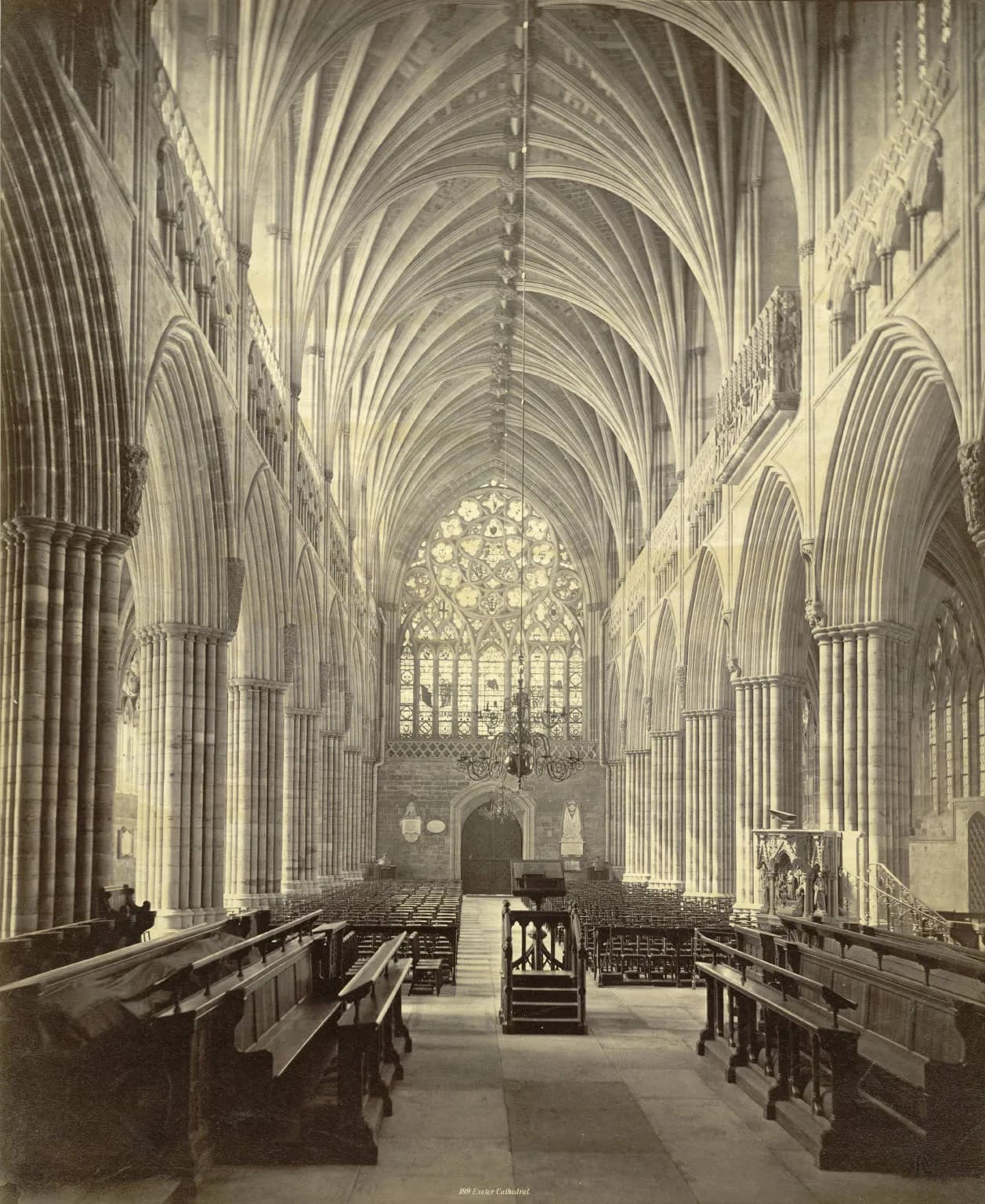
Exeter Cathedral houses the longest uninterrupted medieval stone vaulted ceiling in the world, stretching approximately 96 metres above the nave. The structure represents more than two centuries of continuous building, from its Norman origins to its completion around 1400.
A Site Layered With History
The cathedral close occupies ground that has served as a place of power for nearly two millennia. The site was previously home to Roman buildings, including a legionary fortress dating from 50 to 75 AD; a Roman bathhouse was discovered here in 1971. Before the present building, a Saxon minster dedicated to Saint Mary and Saint Peter stood on the same spot, and in 1050 Bishop Leofric moved his seat from Crediton to Exeter, establishing the foundation of the cathedral as it is known today.
The Norman Cathedral
Construction of a new Norman-style cathedral began in 1112 under Bishop William Warelwast, who had been appointed in 1107. The building was officially founded in 1133, by which time the choir, transepts and first two bays of the nave were likely complete. The nave and west front were finished by 1160, with a cloister and chapter house added between 1180 and 1244.
The Gothic Rebuilding
In 1258, Bishop Walter Bronescombe initiated an ambitious project to rebuild the cathedral in the Decorated Gothic style. Much of the Norman structure was retained, including the two massive square towers built between 1114 and 1133, which were incorporated into the new design as transepts. This required a significant engineering feat: portions of the inner walls were removed and supporting arches inserted to join the old masonry to the new. The Gothic rebuilding continued for more than a century, and the cathedral was largely complete by about 1400.
The Nave Vault: Scale and Craft
The nave is covered by a continuous run of tierceron vaults that extend for roughly 96 metres, or 315 feet, without structural interruption. Over 400 carved stone bosses join the ribs at the peaks of the vault; one of these bosses depicts the murder of Thomas Becket. The architecture appears harmonious despite bays of irregular size, and the plan is based on a division into ninths. The entire building was constructed of local stone, including Purbeck Marble.
The Master Builders
Several master masons left their mark on the fabric of the cathedral. Master Thomas of Witney was engaged in 1316 to design choir furnishings and served as master mason until 1342; during his tenure the east cloister walk was begun and the nave, west front and north cloister walk were likely completed. He was succeeded in 1342 by William Joy, who is believed to have designed the image screen across the west facade and Bishop Grandisson's chantry chapel. From 1377 to 1414, Master Robert Lesyngham finished the remaining cloister walks and probably designed the great East Window, which was glazed in 1391 and incorporates 14th-century glass dating from around 1304.
War, Restoration and Survival
The cathedral has survived periods of conflict and change. Victorian refurbishment was carried out by George Gilbert Scott. On 4 May 1942, during the Baedeker Blitz, a high-explosive bomb struck the building, demolishing the chapel of Saint James, the muniment room above it, three bays of the aisle and two flying buttresses. Many important artefacts, including ancient glass, misericords, the bishop's throne, the Exeter Book and ancient charters, had been removed for safety beforehand; Walter Branscombe's effigy was protected by sandbags. The medieval wooden screen opposite the chapel was smashed but later reconstructed. Saint James' Chapel was rebuilt after the Second World War, incorporating a memorial to Polish airmen who defended Exeter during the conflict.
An Exeter Landmark Today
The cathedral remains an active Anglican church and the seat of the Bishop of Exeter, situated at the heart of the city between the Close and the High Street. Its interior contains other notable features, including the Minstrels' Gallery dating to around 1360, which is unique among English cathedrals and displays twelve carved angels playing medieval musical instruments, and the Bishop's Throne, made from local Devon oak between 1312 and 1316, standing 16 metres high. The astronomical clock in the north transept bears a main dial from 1484 and the Latin inscription "Pereunt et imputantur" beneath it.