Beneath the Pavement: A Hidden Medieval World
Deep beneath Exeter's busy streets lies a remarkable survivor of medieval engineering. The city's underground passages, the only known example of their kind in the United Kingdom, have carried water to Exeter's citizens for nearly 800 years.
Origins of an Ancient Water Supply
The story begins with the Romans, who tapped springs in the parish of St Sidwell's east of the city centre. They constructed wooden aqueducts to pipe water to the Roman citadel that once dominated Exeter. This early infrastructure provided the foundation for what would become one of medieval England's most sophisticated urban water systems.
The earliest surviving passages date to the 13th century, when Exeter's growing population demanded a more reliable water supply. A formal system was installed in the 12th century, with significant expansions during the 14th and 15th centuries. The network was designed to supply Exeter Cathedral, St Nicholas Priory, and public fountains throughout the walled city.
Engineering Solutions for a Growing City
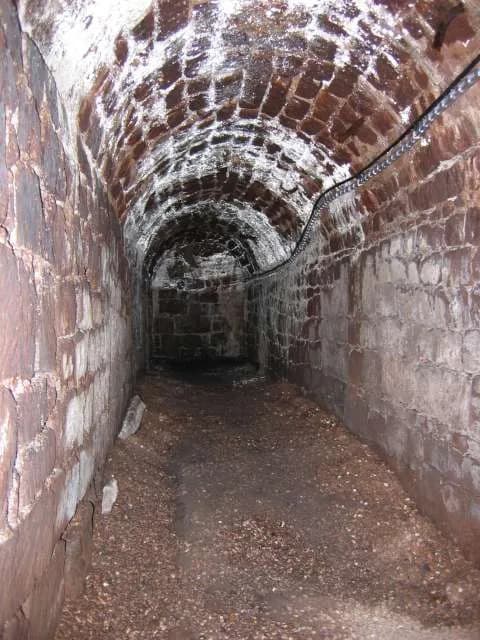
Medieval engineers faced a practical problem: water pipes buried beneath city streets would require disruptive excavations whenever repairs were needed. Their solution was characteristically ingenious. They constructed cut-and-cover vaulted conduits, housing lead pipes within accessible underground passages that could be maintained without digging up the streets above.
The passages were built using blocks of lava rock quarried from Silverton, a village near Exeter. Castle Passage, the main accessible tunnel, stands at a uniform height of approximately five feet two inches; narrow enough that only one person can pass at a time. The design prioritised function over comfort, creating a cramped but practical maintenance route that served the city for centuries.
Civil War Secrets and Centuries of Service
The passages contain physical evidence of Exeter's turbulent past. A small ledge in Castle Passage marks the location of a Civil War-era guard station, dating from the period when Exeter served as a Royalist stronghold during the English Civil War of 1642 to 1646. This modest feature offers a tangible connection to one of the most violent periods in the city's history.
The water system remained in active service until 1902, an extraordinary span of continuous operation. For nearly two millennia, from Roman aqueducts to medieval vaulting, Exeter drew its water from the same source in St Sidwell's. The decommissioning of the system marked the end of one of Britain's longest-running pieces of urban infrastructure.
Public Tours and the Heritage Centre
Guided tours of the passages have operated continuously since the 1930s, making this one of Exeter's longest-established visitor attractions. The site holds scheduled monument status, recognising its national importance as a rare surviving example of medieval urban water infrastructure.
Three main passages are open to public tours: Castle Passage, City Passage, and Cathedral Passage. Visitors enter through a modern facility at 2 Paris Street, located off Exeter High Street near Sidwell Street, between the Next store and the rear of the Zara store. The attraction lies approximately 45 metres from the Princesshay car park, with Exeter Central and St James' Park railway stations both around a 15-minute walk away.
All tours are guided and limited to a maximum of 15 people. The standard experience includes a 10-minute introductory film, followed by a 25-minute guided underground tour, and time to explore the above-ground Heritage Centre exhibition. Visitors must wear hard hats provided by the attraction; no bags, including handbags, are permitted underground, though secure storage is available.
What Visitors Can Expect
The Heritage Centre offers interactive displays including a talking medieval figure, high-speed video fly-through of the passages, and a full-size passage model. Artefacts from the 2000s Princesshay redevelopment archaeological dig are on display, connecting the medieval water system to modern Exeter's urban development. Interpretation boards are available in large text and in French, German, and Italian translations; the pre-tour film has English, German, and French subtitles.
The passages themselves are not suitable for all visitors. Those under five years of age are not permitted on underground tours, though they may access the Heritage Centre free of charge. Wheelchair and pushchair access is restricted to the Heritage Centre only; the passages themselves are narrow and uneven, with low vaulted ceilings and unlit sections. Visitors prone to claustrophobia should consider carefully before booking, and sensible footwear is recommended.
Practical Information
Entry fees as of 2024 are £7.50 for adults, £6.00 for concessions, £5.00 for children, and £22.00 for a family ticket covering two adults and up to three children. Group discounts are available with 14 days' advance booking and a £25 deposit.
Opening hours vary by season. During term time, tours run Thursday to Sunday from 11am to 4pm, with the last tour at 3pm. During summer holidays, the attraction opens Wednesday to Friday from 11am to 4pm and Saturday to Sunday from 10am to 4pm. The attraction is closed on Mondays and Tuesdays during term time.
The attraction hosts annual special events including an Easter egg hunt, Beneath the Blitz (a World War II air raid experience), and a Christmas in Exeter festive event. Private group tours can include optional crawl sections with modern Acrow supports for those seeking a more adventurous experience.
A Unique Legacy
Exeter's underground passages represent a rare intersection of medieval engineering, urban planning, and modern heritage preservation. The decision to vault water pipes in accessible passages, rather than burying them beneath cobbled streets, demonstrates a level of forward-thinking urban management that was not widely adopted in other medieval British cities. The result is a unique survival: the only known example of this type of vaulted medieval water supply tunnel in a UK city.
For Exeter residents and visitors alike, the passages offer something increasingly rare in modern Britain: the opportunity to walk through genuine medieval infrastructure, unchanged in its essentials since the 14th century. The water no longer flows, but the passages remain, a testament to the ingenuity of those who built a city that could sustain itself from beneath the ground.